


Séminaire transversal du laboratoire FoAP
22 juin 202614h - 17h
292 Rue St Martin, 75003 Paris
Salle 17.2.07
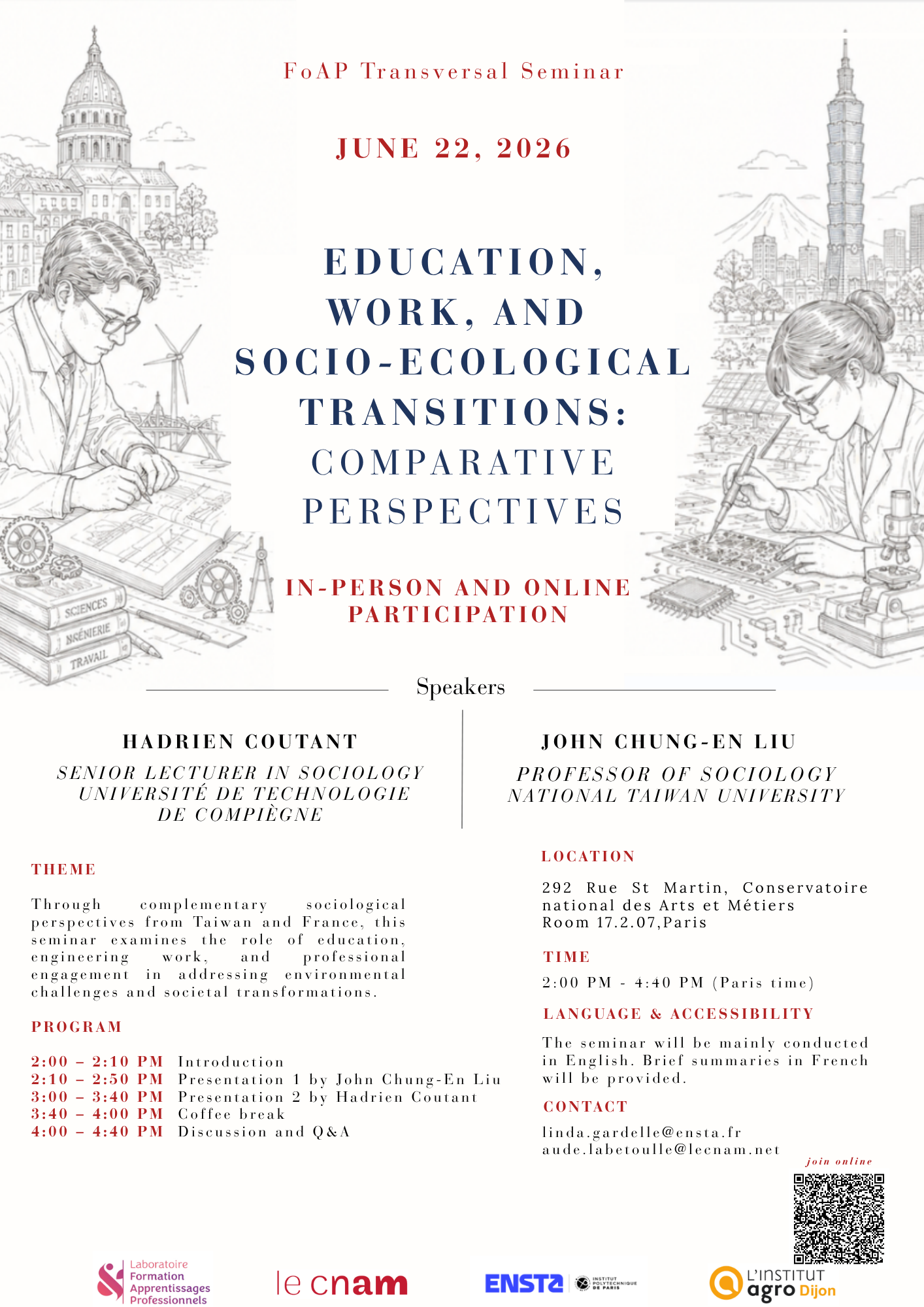
“Education, Work, and Socio-ecological Transitions: comparative perspectives”
Le séminaire se déroulera en anglais, avec traductions en français
Engineers, Higher Education, and Just Transition in Taiwan’s Net-Zero Project
John Chung-En Liu, Professor at National Taiwan University
Taiwan’s net-zero transition is often framed as a challenge of technological innovation, which places engineers at the center of decarbonization efforts. Yet the emergence of just transition as a policy framework has broadened the agenda to include social inequality, land use, and democratic participation. This presentation analyzes how engineers are trained for this transition by situating engineering education within Taiwan’s developmental-state legacy. The presentation argues that Taiwan does not lack technical capacity. Rather, the challenge is to transform technical capacity into just-transition capacity. This requires more than the addition of sustainability content to engineering curricula. It requires a broader sociotechnical imagination that enables future engineers to understand technical systems as social and political systems. By placing Taiwan in comparative dialogue with the French case, the presentation reflects on how different national histories shape engineers’ ecological commitments, public responsibilities, and relationships to work.
Becoming an ecologist engineer : environmental commitment through and in engineering work
Hadrien Coutant, Lecturer at the University of Technology of Compiègne
This talk examines the motivations and effects of ecological commitment by and in the work of engineers. The high visibility of engineers in recent environmental movements in France raises questions, since engineers are not very politicized and keep their distance from major social issues and militant worlds. The ecological commitment of engineers often remains rooted in an expertise specific to engineers, as shown by the emergence of the ‘low-tech’ movement and the creation of organizations on the edge of activism and research-action. This presentation analyzes the reasons for the ecological commitment of engineers through their work, simultaneously ideological—the congruence of contemporary ecological framing, centered on expertise and the energy-climate issue, with engineering thinking—, organizational—the development of engineering professions resulting from the relative internalization of ecological constraints by firms—and work-related—criticism of the deskilling and growing alienation of engineering work, often summarized in terms of the “loss of meaning” at work. The extreme case of engineers in terms of low political commitment sheds light on the interactions between work and commitment in the graduate upper classes.




22 juin 202614h - 17h
292 Rue St Martin, 75003 Paris
Salle 17.2.07

